It is raining, finally! 2013 was one of the driest years on record and 2014 has started off to be drier. Drought and water conservation is on everyone’s mind and the topic of conversation where ever you go in Chico and the Northstate. Walking through my neighborhood in the rain this morning I couldn’t help but notice all the rainwater pouring out of downspouts, down driveways and walkways, and into the gutter. My feet get soaked wading through the streams of runoff crossing sidewalks. In a week or two, after the rain stops again, many will wish that the rain that went down the drain could have been used to water their landscape and gardens, if they had only harvested the runoff.
Harvesting rainwater is nothing new, it has been happening since people figured out how to build catchments, of course that lead to dam building. The drawing below is from a 1909 publication on how to be self-sufficient. It is a rain barrel designed to provide potable water, which is not allowed with today’s catchment systems unless they get a health department certification and contain elaborate water purification systems installed, not just sand, gravel, and charcoal.
 Source: “Household Discoveries and Mrs. Curtis’s Cookbook” 1909
Many homes in the Midwest have cisterns that collect rainwater or have used rain barrels for years. California’s latest drought has brought a resurgence in rainwater harvesting. However, installing rain barrels or cisterns in the middle of a drought doesn’t help much. A couple communities in California are offering rebates (one offers $100 rebate and another $1 per gallon up to $400 per household) to install rain barrels on your downspouts.
Fortunately the California Rainwater Capture Act of 2012 (AB 1750) was signed into law two years ago and it allows rainwater to be collected and used without requiring a “water right permit” (whatever that is; however, local building code requirements may apply if a city creates them like Berkeley and San Diego) and allows landscaping contractors to install rainwater harvesting systems.
Why Harvest Rainwater?
First, it is free water and is relatively pollutant free and contains no minerals (soft water). You don’t want to use the rainwater collected after the first rainfall of the season in the fall. As “stuff” that has settled on your roof will be washed off into the water. We do live in an agricultural area and the fall harvest dumps tons of dust, herbicides, and pesticides into the air that ends up on our roofs.
Second, rainwater running off your property and into the storm drain doesn’t end up where it belongs, in the aquifer. Normally it would have soaked into the soil and what isn’t transpired ended up in the surface aquifer. Keeping it on-site and letting it soak into the ground is a good thing for the aquifer that supports our urban forest.
Third, it can displace water from your local water supplier if you use it to water your garden or yard and not only save water but money too.
How Much Rainwater is Available?
Here in Chico there is too much rainwater when you don’t need and not enough rain when you do (a good reason for storing it). The historic average rainfall in Chico is 26 inches a year. However, it falls mainly from November through March (see chart below), which is typical in Mediterranean climates, when it isn’t needed for landscaping as most yard plants and lawns are dormant in the winter. However, from April through October, when it is needed, we are in drought conditions with little or no rain and high evapotranspiration requirements due to our high temperatures and low humidity levels. Capturing the rainfall from an entire rainy season isn’t practical in most urban settings. It only practical if you invest in a large cistern system.

One inch of rain falling on a 1,000 square foot surface will produce 623 gallons of water. Here in Chico with 26 inches of rain a year (when it rains) a 1,000 sq.ft. surface could collect about 16,200 gallons of water. According to the Department of Water Resources the average California household consumes almost 24,000 gallons or water per month, about half of which is used for interior uses (toilets, faucets, showers, clothes washing, etc.) and the other half for exterior uses (landscaping, pools, washing cars, etc.). The State will not let you use rainwater for potable uses; therefore, it will need to be used for your landscaping and gardening. The 16,200 gallons you collected would provide you with six weeks of landscape and garden watering. If you thought about using 55-gallon rain barrels to capture all of your roof runoff you would need 295 of them.
The chart below illustrates the number of rain barrels per month needed to store the water collected from a 1,000 sq.ft. roof.

Calculating Rain Water Runoff
The amount of rain that falls on a roof can be calculated by finding the area of your roof’s footprint and not the area of the roof. My house is roughly 24 feet by 50 feet and the roof overhangs 1.5 feet, so I would add 3 feet to each dimension to give me 27 feet by 53 feet, or 1,431 square feet of rainwater collector surface.

Source: The Texas Manual on Rainwater Harvesting, Texas Water Development Board
Rainwater Collection Formula
To determine the amount of rainwater you can capture a little math must be done. Since rain falls on surfaces we need to know the area of the surface the rain is falling on and the depth of the rain falling on that surface to get the volume of water. I have already determined that the amount of rainwater in a 1-inch rain that can be collected is equal to the area of the footprint of the roof times the 0.623 gallons per square foot.
Gallons of Rainwater = Roof Area (sq.ft.) x 0.623 gallons/sq.ft./inch or rain = # gallons/inch of rain
Using my house, the area of my roof footprint is 1,431 sq.ft., so the quantity of rainwater can be determined:
My house = 1,431 sq.ft. x 0.623 gallons/sq.ft. = 892 gallons/inch of rain
So every time we get a 1-inch rain, 892 gallons of rain falls on my roof. In a year over 22,300 gallons will fall on it.
Annual Rain Collection = 892 gallons/inch of rain x 26 inches of rain/year = 22,300 gallons/year
Of course not all of the rainfall will be harvested, some evaporates and some never makes it into the catchment system and you might only end up with 80 – 90 percent of the total amount. Since you probably aren’t going to collect it all anyway don’t worry about what you aren’t collecting in the first place.
One further refinement that may be important is estimating the rainfall production by roof slope or by downspout so that your catchment system can be adequately sized for the surface it collects. A simple roof rain-gutter system typically has one downspout per slope. The image below illustrates the capture areas of each downspout. You can calculate the amount of water available from each downspout the same way as shown above. Measure from the peak of the roof to the edge of the roof on each slope. If one downspout serves two slopes calculate the area served by the downspout.
 Source: City of San Diego Rainwater Harvesting Guide.
Once you’ve figured out the relative quantities of water that can be captured from each downspout the next step is to figure out how many rain barrels you want to place at each downspout. How much rainwater you collect, store, and use depends on how you are going to use it, how much you can afford, and the space available in your yard. Placing one or two rain barrels at each downspout will provide you with some extra non-chlorinated water to use in your garden or household plants and will make a small dent in your water bill.
Rainwater Harvest System
We will be addressing rain barrels; however, if you are serious about harvesting rainwater a cistern may be more in line with your needs. There are numerous rainwater harvesting websites that contain a lot of information for larger, permanent systems.
A rain barrel system is relatively simple to design and install. Nani Teves, the “Chico Queen of Rain Barrels”, holds periodic rain barrel workshops (check out the Butte Environmental Council’s website http://www.becnet.org/events/rainwater-catchment-workshop). It basically involves a barrel connected to the downspout in some way, with a screened opening to keep the stuff and mosquitos out, an overflow system, and a spigot to get the water out.
 Source: City of Berkeley, Rainwater Harvesting
Collect the water that runs off your roof and store it in barrels or cisterns. The City of Chico has no rainwater harvesting requirements for rain barrels (some cities have permit requirements for rain barrels and cisterns). The most basic systems place a barrel under a downspout and let the downspout run into the barrel at the top. The barrel has a hose bib at the bottom to allow you to use the water and drain the barrel.
 Source: City of San Diego Rainwater Harvesting Guide.
Barrels can be purchased from rainwater harvesting companies on-line of you can use retired olive barrels (a good source are the olive producers in Corning and Oroville). Recycled olive barrels are cheap and can be found for $10 – $30 per 55-gallon barrel. Hose bibs are around $5.
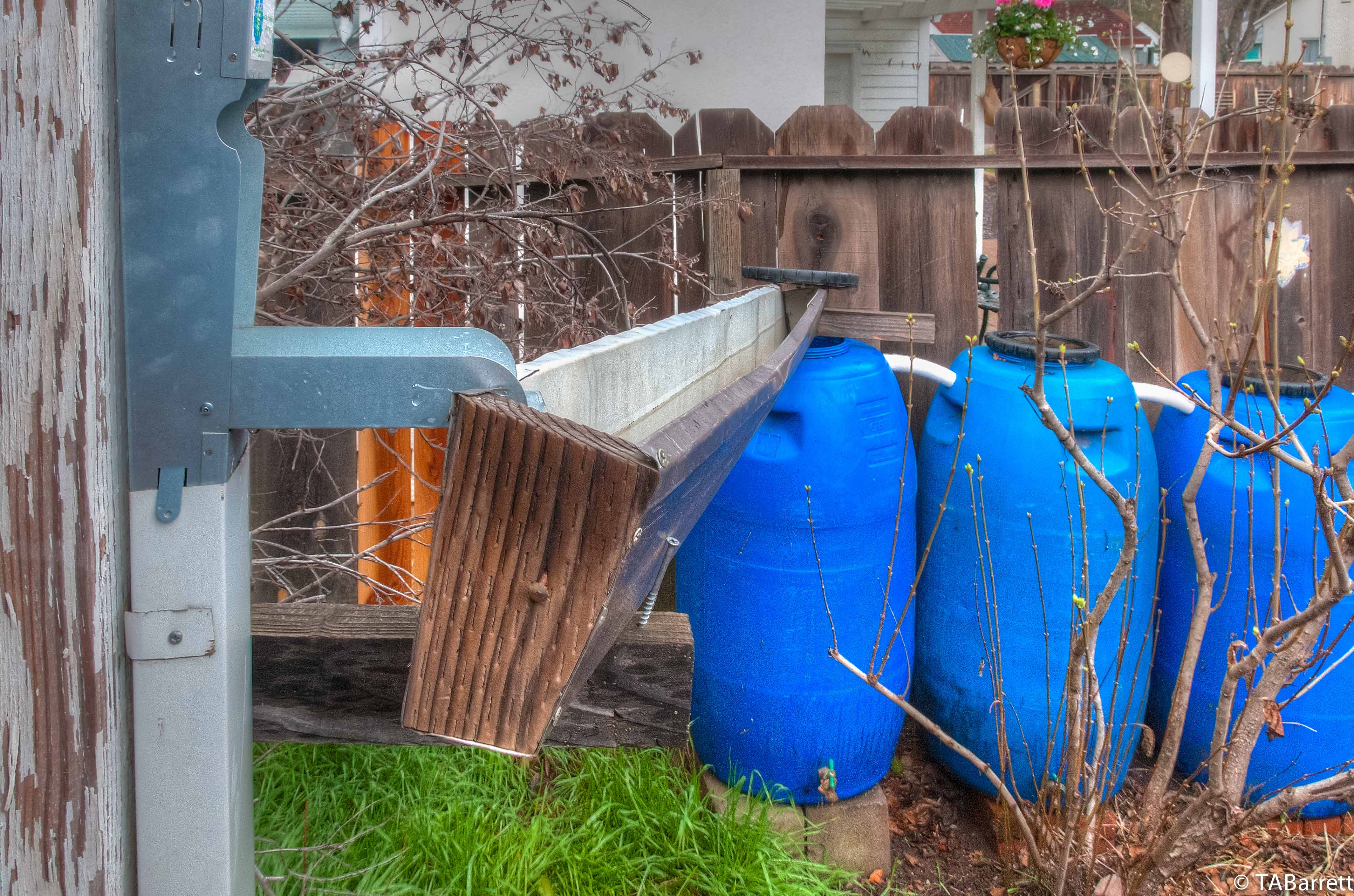
Rainwater catchment system with downspout diverter and barrels.

Rainwater catchment system.
Conclusion: To Harvest Rainwater or Not
Harvesting rainwater in Chico will provide a little more than a drop in a bucket, but it will provide something. Someone once said, “It don’t matter what you do as long as you do something.” Collecting rainwater even in one barrel is something.
Don’t collect rainwater to save money, you probably won’t notice any savings. In Chico 100 cubic feet (Ccf) of water (water is not sold by gallons but in hundred cubic feet quantities) cost $0.92. If you were able to reduce your water bill by all the rain running off of a 1,000 square foot roof in Chico, the 16,200 gallons (21.7 Ccf) you would collect will save you $20 a year.
The biggest problem with rainwater harvesting in Chico is that most of the rain occurs over a four or five month period in the winter when it isn’t really needed, and then is it doesn’t rain for four or five months straight during the summer when you need it the most. Rainwater collected in the winter would have to be stored until it was needed, in May through October. Four or five, 55-gallon rain barrels wouldn’t provide more than a few weeks of landscape watering or for your food garden.
References:
City of Berkeley, “Rainwater Harvesting Systems”
City of San Diego, “Rainwater Harvesting Guide”
Texas Water Board, “The Texas Manual on Rainwater Harvesting“
 EEECo Chico