ZERO WASTE

What is Zero Waste?

According to the U.S. Zero Waste Business Council (USZWBC, http://www.uszwbc.org ) zero waste is:

a goal that is ethical, economical, efficient and visionary, to guide people in changing their lifestyles and practices to emulate sustainable natural cycles, where all discarded materials are designed to become resources for others to use. Zero Waste means designing and managing products and processes to systematically avoid and eliminate the volume and toxicity of waste and materials, conserve and recover all resources, and not burn or bury them. Implementing Zero Waste will eliminate all discharges to land, water or air that are a threat to planetary, human, animal or plant health.”

The U.S. Zero Waste Business Council utilizes these guiding principles to help businesses and communities achieve over 90% diversion of waste from landfills, incinerators and the environment. They will be holding their “How to Become a Certified Zero Waste Business” training at Sierra Nevada Brewing Company on March 17, 2014 in conjunction with Sierra College’s Center for Applied Competitive Technologies (CACT).

Sierra Nevada Brewing Company has been Chico’s premiere sustainable business and the first firm in the nation to achieve Platinum Zero Waste Certification from USZWBC.

Learn How to Become a Certified Zero Waste Business on March 17

U.S. Zero Waste Business Council is offering a course, to prepare participants for certifications and to institute sustainable business polices that reduce waste and save money, in partnership with Sierra College CACT and host Sierra Nevada Brewing Co. in Chico, CA on March 17.

ROCKLIN – Learn how to achieve Zero Waste Business certification at a March 17 training offered by the U.S. Zero Waste Business Council (USZWBC) in partnership with Sierra College Center for Applied Competitive Technologies (CACT) http://sierracollegetraining.com/. Sierra Nevada Brewing Co. will host the training in Chico, CA and offer a tour demonstrating how the company diverted 99.8 percent of its waste. Register at http://www.uszwbc.org/; the early bird fee is $199 by February 15.

Manufacturers can particularly benefit from this training according to Carol Pepper-Kittredge, CACT Director, Sierra College. “By incorporating sustainability practices, businesses can cut costs, generate revenue and enhance their reputation,” said Pepper-Kittredge. “Working toward Zero Waste naturally complements’ companies’ efforts to reduce energy consumption, make their processes more efficient and become more globally competitive.”

Sierra Nevada Brewing Co. has been committed to a sustainable business model for many years explained Cheri Chastain, Sustainability Coordinator. “Sierra Nevada Brewing Co. was the first firm in the nation to achieve Platinum Zero Waste Certification from USZWBC,” said Chastain. “We are looking forward to hosting this event and sharing with other business leaders how our plant avoided $5,398,470 in disposal costs and generated $903,308 in revenue.”

Sue Beets-Atkinson, USZWBC president, indicated that the six-hour course plus tour of Sierra Nevada Brewing Co. Zero Waste Program will provide attendees with an overview of the USZWBC Zero Waste Business Scorecard certification system. “The course will outline the definition of Zero Waste and give corporate examples of Zero Waste policies and programs,” said Beets-Atkinson.

“Participants will benefit from a detailed explanation of the certification Scorecard, including case studies that demonstrate how to achieve credits. Attendees will also receive the new USZWBC Zero Waste Business Handbook, developed in collaboration with Sierra College CACT.”

For registration and to view details about the training program and individual and business certifications, please visit the U.S. Zero Waste Business Council website: http://www.uszwbc.org/.

Contacts:

Sue Michaels/Diane Wright
Sierra College Marketing/Public Relations
916-660-7272, 916-630-4535(fax)
smichaels@sierracollege.edu or dwright@sierracollege.edu

Gary Liss, Vice-President
U.S. Zero Waste Business Council
916-652-7850
ga…@garyliss.com


Rainwater Harvesting

It is raining, finally! 2013 was one of the driest years on record and 2014 has started off to be drier. Drought and water conservation is on everyone’s mind and the topic of conversation where ever you go in Chico and the Northstate. Walking through my neighborhood in the rain this morning I couldn’t help but notice all the rainwater pouring out of downspouts, down driveways and walkways, and into the gutter. My feet get soaked wading through the streams of runoff crossing sidewalks. In a week or two, after the rain stops again, many will wish that the rain that went down the drain could have been used to water their landscape and gardens, if they had only harvested the runoff.

Harvesting rainwater is nothing new, it has been happening since people figured out how to build catchments, of course that lead to dam building. The drawing below is from a 1909 publication on how to be self-sufficient. It is a rain barrel designed to provide potable water, which is not allowed with today’s catchment systems unless they get a health department certification and contain elaborate water purification systems installed, not just sand, gravel, and charcoal.
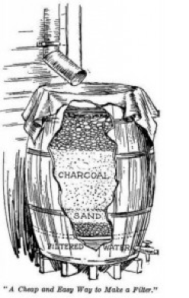
Screen shot 2014-03-04 at 1.59.14 PMSource: “Household Discoveries and Mrs. Curtis’s Cookbook” 1909

Many homes in the Midwest have cisterns that collect rainwater or have used rain barrels for years. California’s latest drought has brought a resurgence in rainwater harvesting. However, installing rain barrels or cisterns in the middle of a drought doesn’t help much.  A couple communities in California are offering rebates (one offers $100 rebate and another $1 per gallon up to $400 per household) to install rain barrels on your downspouts.

Fortunately the California Rainwater Capture Act of 2012 (AB 1750) was signed into law two years ago and it allows rainwater to be collected and used without requiring a “water right permit” (whatever that is; however, local building code requirements may apply if a city creates them like Berkeley and San Diego) and allows landscaping contractors to install rainwater harvesting systems.

Why Harvest Rainwater?

First, it is free water and is relatively pollutant free and contains no minerals (soft water). You don’t want to use the rainwater collected after the first rainfall of the season in the fall. As “stuff” that has settled on your roof will be washed off into the water. We do live in an agricultural area and the fall harvest dumps tons of dust, herbicides, and pesticides into the air that ends up on our roofs.

Second, rainwater running off your property and into the storm drain doesn’t end up where it belongs, in the aquifer. Normally it would have soaked into the soil and what isn’t transpired ended up in the surface aquifer. Keeping it on-site and letting it soak into the ground is a good thing for the aquifer that supports our urban forest.

Third, it can displace water from your local water supplier if you use it to water your garden or yard and not only save water but money too.

How Much Rainwater is Available?

Here in Chico there is too much rainwater when you don’t need and not enough rain when you do (a good reason for storing it). The historic average rainfall in Chico is 26 inches a year. However, it falls mainly from November through March (see chart below), which is typical in Mediterranean climates, when it isn’t needed for landscaping as most yard plants and lawns are dormant in the winter. However, from April through October, when it is needed, we are in drought conditions with little or no rain and high evapotranspiration requirements due to our high temperatures and low humidity levels. Capturing the rainfall from an entire rainy season isn’t practical in most urban settings.  It only practical if you invest in a large cistern system.
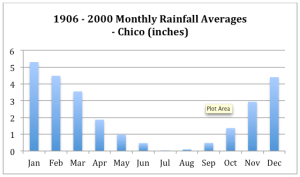
Screen shot 2014-03-04 at 1.57.16 PM

One inch of rain falling on a 1,000 square foot surface will produce 623 gallons of water. Here in Chico with 26 inches of rain a year (when it rains) a 1,000 sq.ft. surface could collect about 16,200 gallons of water. According to the Department of Water Resources the average California household consumes almost 24,000 gallons or water per month, about half of which is used for interior uses (toilets, faucets, showers, clothes washing, etc.) and the other half for exterior uses (landscaping, pools, washing cars, etc.). The State will not let you use rainwater for potable uses; therefore, it will need to be used for your landscaping and gardening. The 16,200 gallons you collected would provide you with six weeks of landscape and garden watering. If you thought about using 55-gallon rain barrels to capture all of your roof runoff you would need 295 of them.

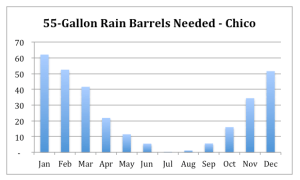
The chart below illustrates the number of rain barrels per month needed to store the water collected from a 1,000 sq.ft. roof.
Screen shot 2014-03-04 at 2.22.13 PM

Calculating Rain Water Runoff

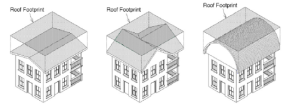
The amount of rain that falls on a roof can be calculated by finding the area of your roof’s footprint and not the area of the roof. My house is roughly 24 feet by 50 feet and the roof overhangs 1.5 feet, so I would add 3 feet to each dimension to give me 27 feet by 53 feet, or 1,431 square feet of rainwater collector surface.
Screen shot 2014-03-04 at 1.58.30 PM

Source: The Texas Manual on Rainwater Harvesting, Texas Water Development Board

Rainwater Collection Formula

To determine the amount of rainwater you can capture a little math must be done. Since rain falls on surfaces we need to know the area of the surface the rain is falling on and the depth of the rain falling on that surface to get the volume of water. I have already determined that the amount of rainwater in a 1-inch rain that can be collected is equal to the area of the footprint of the roof times the 0.623 gallons per square foot.

Gallons of Rainwater = Roof Area (sq.ft.) x 0.623 gallons/sq.ft./inch or rain = # gallons/inch of rain

Using my house, the area of my roof footprint is 1,431 sq.ft., so the quantity of rainwater can be determined:

My house = 1,431 sq.ft. x 0.623 gallons/sq.ft. = 892 gallons/inch of rain

So every time we get a 1-inch rain, 892 gallons of rain falls on my roof. In a year over 22,300 gallons will fall on it.

Annual Rain Collection = 892 gallons/inch of rain x 26 inches of rain/year = 22,300 gallons/year

Of course not all of the rainfall will be harvested, some evaporates and some never makes it into the catchment system and you might only end up with 80 – 90 percent of the total amount. Since you probably aren’t going to collect it all anyway don’t worry about what you aren’t collecting in the first place.

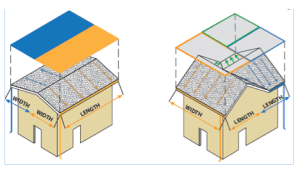
One further refinement that may be important is estimating the rainfall production by roof slope or by downspout so that your catchment system can be adequately sized for the surface it collects. A simple roof rain-gutter system typically has one downspout per slope. The image below illustrates the capture areas of each downspout. You can calculate the amount of water available from each downspout the same way as shown above. Measure from the peak of the roof to the edge of the roof on each slope. If one downspout serves two slopes calculate the area served by the downspout.
Screen shot 2014-03-04 at 1.58.50 PMSource: City of San Diego Rainwater Harvesting Guide.

Once you’ve figured out the relative quantities of water that can be captured from each downspout the next step is to figure out how many rain barrels you want to place at each downspout. How much rainwater you collect, store, and use depends on how you are going to use it, how much you can afford, and the space available in your yard. Placing one or two rain barrels at each downspout will provide you with some extra non-chlorinated water to use in your garden or household plants and will make a small dent in your water bill.

Rainwater Harvest System

We will be addressing rain barrels; however, if you are serious about harvesting rainwater a cistern may be more in line with your needs. There are numerous rainwater harvesting websites that contain a lot of information for larger, permanent systems.

A rain barrel system is relatively simple to design and install. Nani Teves, the “Chico Queen of Rain Barrels”, holds periodic rain barrel workshops (check out the Butte Environmental Council’s website http://www.becnet.org/events/rainwater-catchment-workshop). It basically involves a barrel connected to the downspout in some way, with a screened opening to keep the stuff and mosquitos out, an overflow system, and a spigot to get the water out.

Screen shot 2014-03-04 at 1.59.02 PMSource: City of Berkeley, Rainwater Harvesting

Collect the water that runs off your roof and store it in barrels or cisterns. The City of Chico has no rainwater harvesting requirements for rain barrels (some cities have permit requirements for rain barrels and cisterns). The most basic systems place a barrel under a downspout and let the downspout run into the barrel at the top. The barrel has a hose bib at the bottom to allow you to use the water and drain the barrel.

Screen shot 2014-03-04 at 1.59.23 PMSource: City of San Diego Rainwater Harvesting Guide.

Barrels can be purchased from rainwater harvesting companies on-line of you can use retired olive barrels (a good source are the olive producers in Corning and Oroville). Recycled olive barrels are cheap and can be found for $10 – $30 per 55-gallon barrel. Hose bibs are around $5.

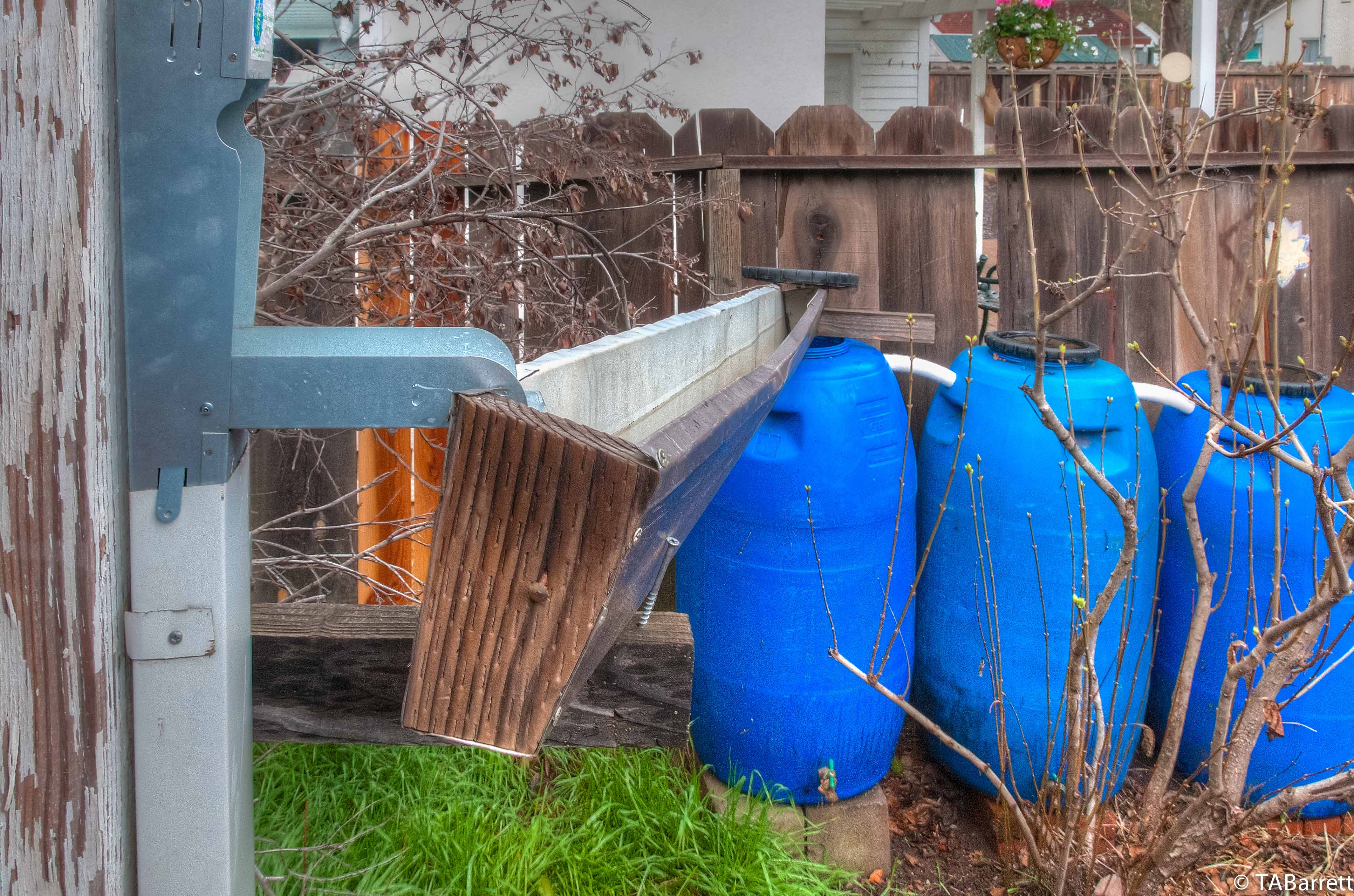
Rainwater catchment system with downspout diverter and barrels.
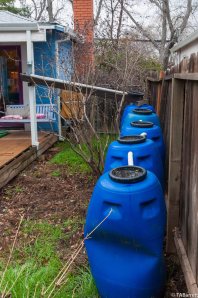
Rainwater catchment system with downspout diverter and barrels.

Rainwater catchment system.

Rainwater catchment system.

Conclusion: To Harvest Rainwater or Not

Harvesting rainwater in Chico will provide a little more than a drop in a bucket, but it will provide something. Someone once said, “It don’t matter what you do as long as you do something.” Collecting rainwater even in one barrel is something.

Don’t collect rainwater to save money, you probably won’t notice any savings. In Chico 100 cubic feet  (Ccf) of water (water is not sold by gallons but in hundred cubic feet quantities) cost $0.92. If you were able to reduce your water bill by all the rain running off of a 1,000 square foot roof in Chico, the 16,200 gallons (21.7 Ccf) you would collect will save you $20 a year.

The biggest problem with rainwater harvesting in Chico is that most of the rain occurs over a four or five month period in the winter when it isn’t really needed, and then is it doesn’t rain for four or five months straight during the summer when you need it the most. Rainwater collected in the winter would have to be stored until it was needed, in May through October. Four or five, 55-gallon rain barrels wouldn’t provide more than a few weeks of landscape watering or for your food garden.

References:

City of Berkeley, “Rainwater Harvesting Systems”

City of San Diego, “Rainwater Harvesting Guide”

Texas Water Board, “The Texas Manual on Rainwater Harvesting

Property Assessed Clean Energy (PACE) Financing for Energy Projects

Want to install a new, energy-efficient heating and air conditioning system? Energy-efficient lighting? Solar water heating or electric systems? Other energy efficiency measures? Here is a new way to finance those projects without having to put any money out up front.

PACE financing is available in Butte County to fund energy efficiency, renewable energy projects, or water efficiency projects. The loan is paid back as a voluntary property tax assessment on your property and is not a “bank” loan. PACE loans can be paid back in 5 to 20 years as it is tied to your property tax bill. PACE eliminated the need to pay out of pocket for your energy improvements.

PACE loans are available for owners of property in the unincorporated area of Butte County, the City of Chico, the City of Oroville, or the Town of Paradise. This financing package is available only for commercial, retail, agricultural and industrial property owners in Butte County.

PACE offers 100% up-front financing for solar, energy efficiency and water conservation improvements and may include:

  • HVAC Systems
  • Solar Photovoltaic
  • Solar Thermal
  • Roofing
  • Lighting
  • Windows
  • Exterior Doors
  • Plumbing
  • Irrigation
  • Process Equipment
  • Control Systems

PACE gives property owners unparalleled flexibility and benefits:

  • 100% up-front financing
  • Long terms (up to 20 years)
  • No encumbrance of corporate credit
  • Transferability of lien upon disposition
  • Repayment via property tax bill
  • Potential off balance sheet treatment

An energy audit or ‘test in, test out’ procedures to ensure optimum operation is not required; however, it is highly recommended. You can also use PG&E rebates and other incentive programs such as RHA’s Energy Fitness Program in addition to PACE funding.

For more information:

Visit the Butte County website:

http://buttebusinessresources.com/property-assessed-clean-energy-pace

Butte CountyThe Butte County PACE program is operated by FIGTREE.  Visit the FIGTREE website to begin your application or call 877.577.7373.

Water Conservation Measures – Toilets

High Efficiency Toilets (HETs)

It is time for toilet talk. In a previous post I provided CalWater’s list of rebates for water conserving devices. Hopefully you all sign up for the water conservation kit and they are sending it to you in four to six weeks (really it takes that long?). There were two different rebates for high efficiency toilets. This rebate requires you to install the toilet, fill out a form, send it in with the receipt, and wait six to eight weeks for your check.

CalWater lists two different toilet rebates (the form is available on-line www.calwater.com) one for $50 and the other for $100.  The $50 dollar rebate is for a non-premium, high-efficiency toilet and the $100 one is for a premium HET (nothing is too good for your poo). High efficiency toilets (HET) are those that use 1.28 gpf or less.

I have two toilets in my house. One is an original 50-year old toilet that was installed when my house it was built in 1955.  Toilets are date stamped and my tank says it was manufactured in August 1950.  It stores 5 – 6 gallons of water in the tank and flushes about 5 gallons per flush (gpf). That is 3,650 gallons a year if I flushed two times a day! I adjusted the float valve years ago so that it only flushed 4 gallons. My second toilet is a newer, low flow, 1.6 gpf toilet installed six years ago. Since I live alone only the newer toilet is used on a regular basis, so the older one hasn’t been a retrofit priority for me. With rebates available and drought looming I thought it might be time to flush my old one no more.

So I checked prices for new low-flow toilets. I was potty shocked. The premium HETs ranged in price from $600 – $1,200 and I’m sure there are more expensive ones, but heck you can get a $100 rebate (if there is rebate money left)! Since none of these premium units were self wiping I decided to look at the “non-premium” ones. These ranged in price from $130 to $600, a little more in my price range and they were the same size as the premium ones.

I’ll be doing some plumbing this weekend it looks like. Just in time too. I’m replacing my old fireplace insert with a new EPA-certified fireplace insert utilizing a $1,000 rebate from the Butte County Air Quality Management District (more on that in a later post – they are out of money right now) and new building codes require that whenever you get a building permit, yes even for installing a fireplace insert, you have to bring your pre-1994 toilets up to code.

Remember if you are planning on remodeling or doing anything that requires a building permit plan on upgrading your pre-1994 toilet with a new 1.28 gpf HET.

Toilet Water Saving Measures

If you don’t have $200 or more to put into a HET there are other options for saving water with your water closet:

  1. If it is brown, flush it down. If it is yellow, let it mellow.
  2. Adjust the float valve so that it shuts off before it fills all the way.
  3. Place food dye (toilet test kit) in the tank and see if any of the dye ends up in the bowl. If it does the flapper valve is leaking or the float valve is not shutting off. Repair it.
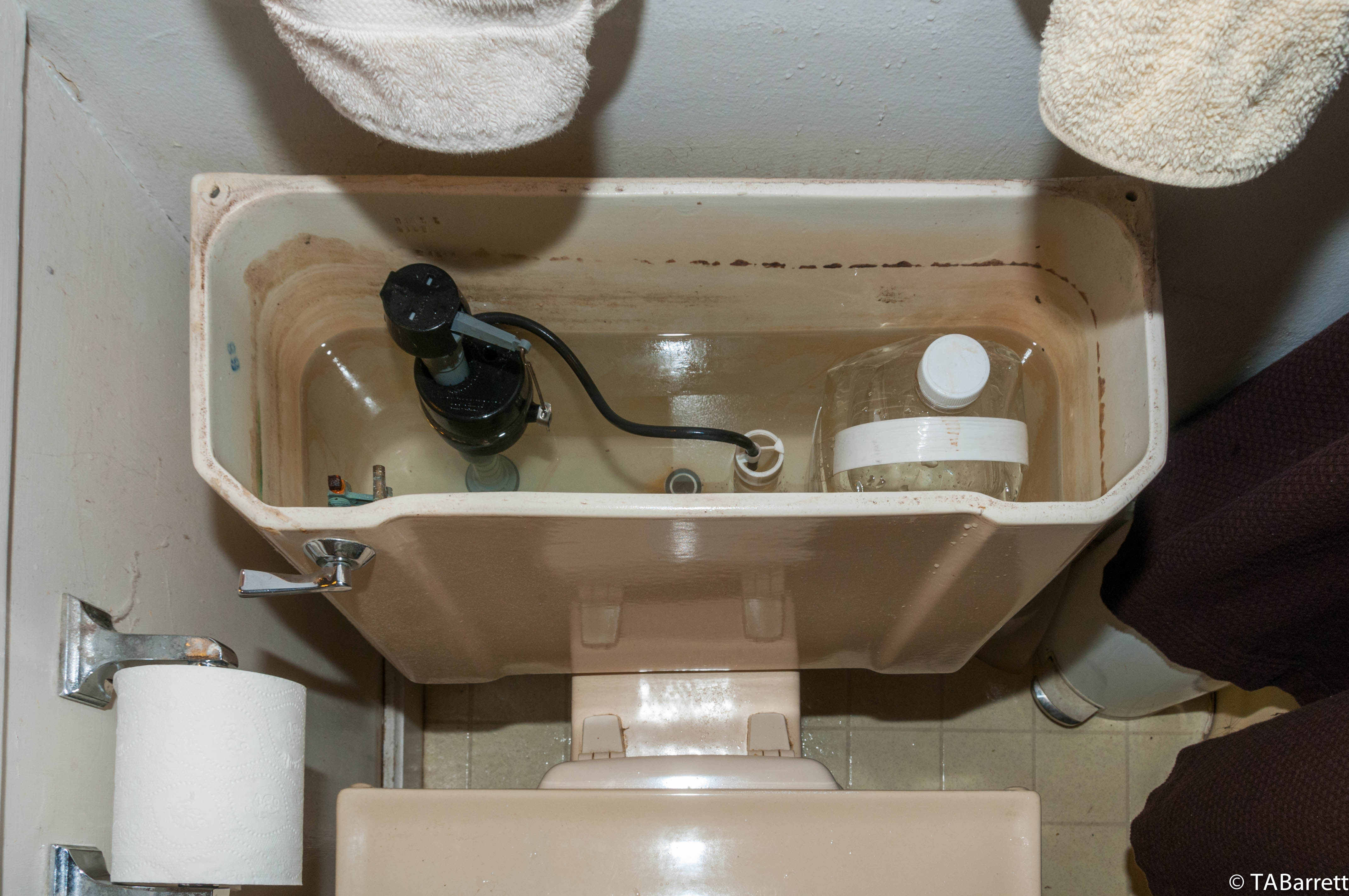
  4. Place a water bottle in the tank. Use liter or gallon plastic bottles filled with water into the tank to reduce the amount of water in each flush.
Reduce amount of water in the tank with a filled water bottle.

Reduce amount of water in the tank with a filled water bottle.


Water Conservation Devices and Rebates Available from Cal Water

Cal Water will provide you with a FREE water conservation kit if you apply on-line or go to their office next to CostCo. They also have rebates for toilets, washing machines, and lawn sprinkler controllers for single-family customers and irrigation control and sprinkler heads for commercial customers. Take advantage of these as the kits and rebates are limited and on a first-come first-serve basis.

If you need help installing these devices call friends or trade for services.

Cal Water Conservation Kits

Cal Water is providing water conservation kits for single-family residential customers. These kits are available at no charge to help make conserving water that much easier.

Each kit includes:

  • Two high-efficiency showerheads (use 2 gallons per minute [gpm])
  • One hose nozzle
  • Two bathroom faucet aerators (use 1.0 gpm)
  • Toilet leak tablets
  • One kitchen faucet aerator (uses 1.5 gpm)

These fixtures are available to current Cal Water single-family residential customers while supplies last, and will be mailed to the service address on record. There is a limit of one kit per service address per three-year period.

https://www.calwater.com/conservation-kits/

Cal Water Residential Water Conservation Rebates for Chico and Oroville

High-efficiency toilet rebate (Non-Premium Models)

Amount: Up to $50

Eligible Devices: Non-Premium Models from this list

WaterSense labeled toilets are independently certified to meet rigorous criteria for both performance and efficiency. WaterSense labeled toilets must use 1.28 gallons per flush or less and meet a minimum MaP threshold of 350 grams of waste removed from the toilet fixture in a single flush.

High-efficiency toilet rebate (MaP Premium Models)

Amount: Up to $100

Eligible Devices: Premium MaP Models from this list

In addition to meeting the rigorous performance standards of WaterSense labeled toilets, MaP premium toilets must use 1.06 gallons per flush or less and meet a minimum MaP threshold of 600 grams of waste removed from the toilet fixture in a single flush.

High-efficiency clothes washer rebate

Amount: $150

Eligible Devices: Devices from this list

High-efficiency clothes washers use 35-50% less water and approximately 50% less energy than traditional washers. See the rebate application for additional restrictions and qualifications.

Smart Irrigation Controller rebate

Amount: Up to $125

Eligible Devices: Devices from this list

Smart Irrigation controllers automatically adjust their watering schedule in response to changing weather conditions. See the rebate application for restrictions and qualifications.

Commercial Water Conservation Devices Rebates – Chico and Oroville

Smart Irrigation Controller rebate

Amount: Up to $25 per station

Eligible Devices: All devices from this list

Smart Irrigation controllers automatically adjust their watering schedule in response to changing weather conditions. See the rebate application for restrictions and qualifications.

Free Sprinkler Nozzles

To help you save water, Cal Water is partnering with FreeSprinklerNozzles.com to make water-saving Toro Precision Series Spray Nozzles available at no charge to our customers. Visit www.freesprinklernozzles.com to receive a voucher for free spray nozzles. For more information, visit the Free Sprinkler Nozzles page.

Rotating Nozzle rebate

Amount: Up to $5 per nozzle

Eligible Devices: Devices from this list

Rotating nozzles save water by applying water more slowly and uniformly, minimizing run-off. See the rebate application for additional restrictions and qualifications.

Spray Body with Integrated Pressure Regulation and Check Valve rebate

Amount: Up to $10 per body (material)
Up to $8 per body (installation, if installed by C-27 contractor

Eligible Devices: Devices from this list

Spray bodies with integrated pressure regulation and check valves save water by providing optimal pressure and minimizing loss of water through low-head drainage. See the rebate application for additional restrictions and qualifications.

Chico’s Not So Livable Wages

There has been a lot of discussion lately about raising the minimum wage to a livable wage. Wages paid to American workers have not kept up even with the low levels of inflation. The proposal to raise the Federal minimum wage to $10.10/hour is a start but is still well below a livable wage in most places including Chico and Butte County. If minimum wages kept up with inflation over the past 30 years they would be around $21/hour in 2014, not $10.10.

According to the California Budget Project a “livable wage” in Butte County for one person in 2013 was $12.80/hour, higher than the current minimum wage is $8.00/hour and the averaged per capita income hourly wage of $11.33. While this increase may seem significant it is still 66% of the median wage and would classify a person as “low-income”. A “low-income”, 1-person household in Butte County earns less than $30,650 a year. That’s $14.74/hour or less and a livable wage would still be below this level!

The California Budget Project’s (CPB, http://www.cpb.org) December, 2013 report, “Making Ends Meet: How Much Does It Cost to Support a Family in California?” analyzed the cost to live in California and each of its counties.  The CBP analyzed the following basic living needs: housing and utilities, child care, transportation, food, health care, miscellaneous expenses (including telephone service, housekeeping supplies, and other basic costs), and taxes.

Livable wage in Chico/Butte County:

  • A single adult needs an annual income of $26,615, or $12.80/hour.
  • A single-parent family with two children needs an annual income of $61,605, or $29.62/hour.
  • A two-parent family with one parent working and two children needs an annual income of $53,138, or $25.57/hour.
  • A family with two working parents and two children needs an annual income of $69,480, or $16.70/hour for each working parent.

How much do people in Chico make? According the latest Census information, American Community Survey (ACS) reports that in Chico:

  • The median household income is $42,896/year, or $20.62/hour, 70% of the State’s median of $61,400.
  • The median family income is $56,301/year, or $27.07/hour.
  • The per capita income is $23,573, or $11.33/hour, 80% of the State’s per capita of $29,551.

The US Census reports that 23% of the population in Chico is below poverty level.