The two biggest “energy” costs that directly and indirectly effect us are utilities (electricity and natural gas) and vehicle fuel (gasoline and diesel). Prices and rates are going through the roof and milking your bank account dry. What can we look forward to and what can you do about it?
Electric Rates
California’s Electric Rates
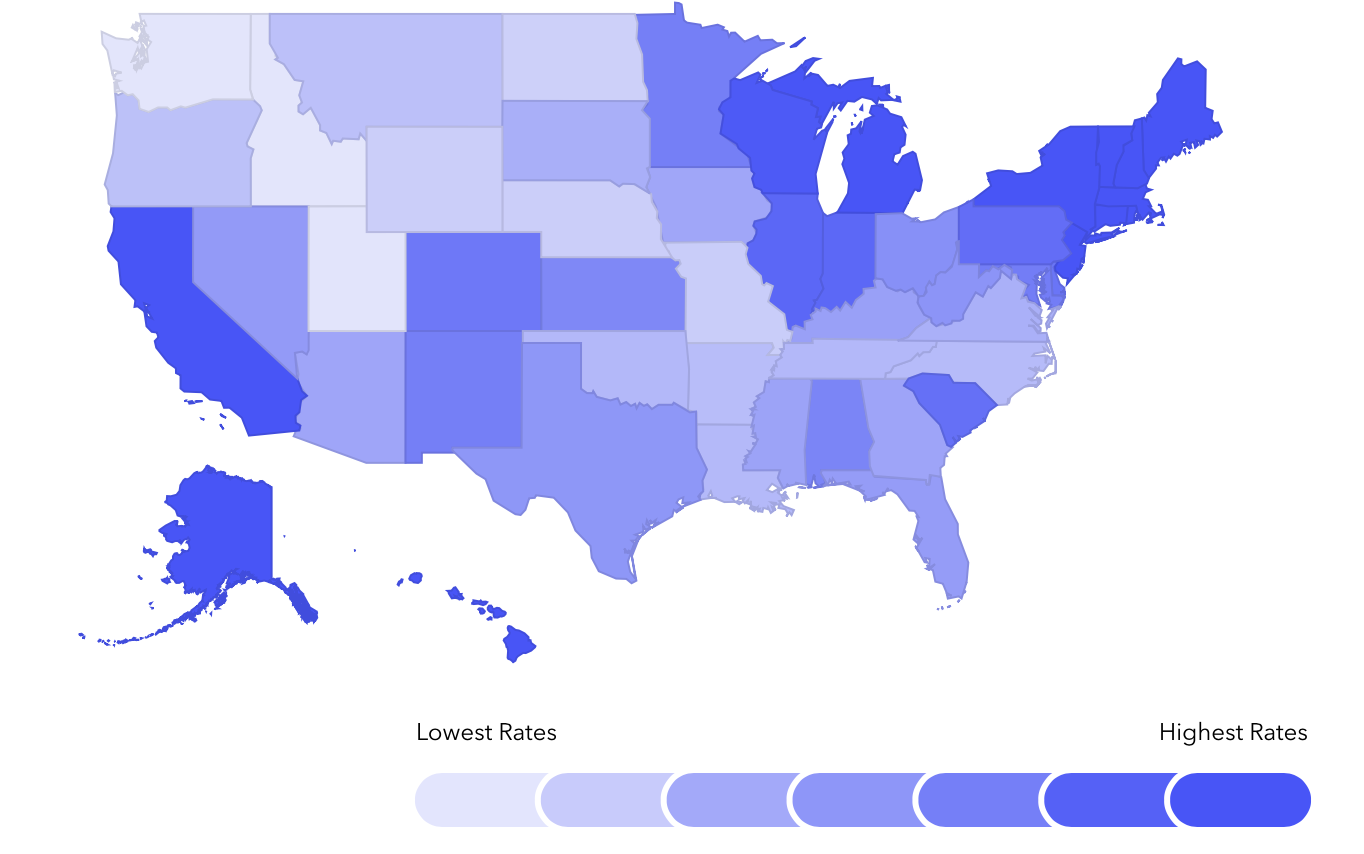
California (with PG&E leading the way) has the highest average electric rates (average 23.76 cents/kWh) in the United States (except for Hawaii 33.97 cents/kWh) and probably North America (EnergyBot.com).
California Utilities New Move to Time of Use Rates For All
All utility customers in California were required by the CPUC (California Public Utilities Commission) in 2019 to be placed on a Time-of-Use rate schedule (aka a tariff) by 2022. PG&E is just in the final stages of doing this to their customers. The reason behind this change in how we are charged for electricity has to do with the production of renewable energy, especially solar. Solar electricity peaks in the late afternoon during the summer in California just as the peak temperatures start and the demand for electricity is the greatest. As solar production drops by evening power has to be produced by nonrenewable sources. Non-renewable power costs more than renewable power and charges will be passed along.
According to Energy Upgrade California (energyupgradeca.org) electrical prices are higher during peak demand hours and lower during off-peak hours and by shifting to Time-of-Use (TOU) rates customers may be able to lower their overall energy costs. The new pricing plan is part of a California Public Utilities Commission (CPUC) effort to support the state’s ongoing shift to cleaner energy. Time Of Use (TOU) plans support a cleaner and more reliable power grid for everyone. The state’s electrical grid is increasingly powered by clean, renewable sources of energy, when the sun is out and the wind is blowing. The challenge is in the late afternoon and evening, when demand for energy peaks. At this time, electricity is more likely to be produced by carbon-intensive energy sources, which emit greenhouse gases.
To help the State shift to cleaner energy the CPUC expects customers to minimize electrical consumption between 4 PM and 9 PM, the “peak”, and shift their usage to “off-peak” times (before 4 PM and after 9 PM to reduce peak power production and save money. The only problem with this theory is that 4 – 9 PM is prime household energy use time when kids are home from school and parents home from work and everything in the home usually happens at this time. Additionally, it is also the peak high temperature time (6 – 7 PM) when outside temperatures are the highest in the summer and residential air conditioning demand is the greatest. It is unlikely that customers will be able to shift enough electricity consumption during off peak periods to “reduce their overall energy costs” and in fact as one looks at the details of the TOU rates costs will increase without extreme conservation efforts.
Tiered vs. Time Of Use Rates
In 1973 the US was thrown in the middle of a worldwide “energy crisis” when the Organization of Petroleum Exporting Countries (OPEC) took control of the exporting and price of crude oil. As a result energy prices rose drastically not only for gasoline but for electricity, which was produce by power plants operating on petroleum.
To encourage customers to conserve electricity, utility companies flipped their tiered rate system that was promoting increased consumption by paying less per kilowatt hour (kWh) the more they used to a tiered rate system that cost a customer more per kWh the more they used. Electricity was no longer the best and the cheapest energy source and owning an “All-Electric Gold Medallion” home would become a burden.

The current Tiered rate system is made up of two components: 1) a specific cost per kWh (kilowatt hour) per tier; and 2) a set quantity of kWh (electrical) consumption per tier, the tier allotment. Customer’s pays an increasing $/kWh whenever the consume enough electricity to put them in the next tier. A Time-Of-Use (TOU) rate system changes the $/kWh based on the time the electricity is consumed as monitored by each customer’s smart meter. It is split up into “Peak” and “Off-Peak” periods of consumption. Consumption during “Peak” periods cost more because supposedly it cost more during that time period to produce electricity and cost less in the “Off-Peak” periods.
PG&E’s TOU-C Rate Schedule is actually a hybrid and is both a TOU and a Tiered system. Customers will now have two consumption (quantity) tiers and four $/kWh rates based on the time of the day that also vary by season (winter/summer rates) the electricity was consumed and use they will have to navigate. There is no way the average customer can understand this rate system and the IOUs count on that because the more confused customers are the easier it is to maintain the rate system.
Tiered Rates
After the energy crises in the 70’s California’s utilities set up a two-tiered system which was eventually changed after a few years to a five-tiered system in the 90’s. To really know what you were paying a customer would have to dissect their utility bill to figure what they were being billed for and how. It was a very complicated system that eventually morphed into a three-tiered system.
California’s IOU petitioned the CPUC to change the five-tiered system to a three-tired system a few years ago. The argument that was presented to the CPUC was that people who used the most were paying the most and it wasn’t fair to them because the customers who used the least were paying the least and a greater share of the fixed costs were being paid by customers consuming more. To make it “fair” the CPUC granted the utilities a rate change that decreased the Tier-1 (baseline) quantities forcing customers who had been managing to keep their consumption in the Tier-1 zone to have to go into the Tier-2 zone when the used the same about of electricity. The IOUs also fought for a per meter charge for all customers to help pay for infrastructure improvements on an even basis.
Residential natural gas rates are also on a similar Tiered system, only it is a two-tiered system with a Baseline Quantity (seasonally adjusted) and Above Baseline Quantity and costs.
Baseline Quantities
The CPUC and California utility companies also created a “baseline” quantity of electrical and natural gas consumption. The baseline quantity is 50 to 60 percent of electricity or natural gas that the average household is expected to use in a certain climatic area. The lowest tiered price is then applied to the baseline quantity.
The Warren-Miller Energy Lifeline Act of 1976 required the CPUC to “designate a baseline quantity of gas and electricity necessary to supply a significant portion of the reasonable energy needs of the average residential customer at rates below average cost.” (Order Instituting Rulemaking R.12-06-013). The Act defines “baseline quantities” as “a quantity of electricity or gas allocated by the [Public Utilities] commission for residential customers based on from 50 to 60 percent of average residential consumption of these commodities, except that, for residential gas customers and for all-electric residential customers, the baseline quantity shall be established at from 60 to 70 percent of average residential consumption during the winter heating season. In establishing the baseline quantities, the commission shall take into account climatic and seasonal variations in consumption and the availability of gas service…”(Public Utilities Code Section 739 (a)(1). The policy goals of the Warren-Miller Act were to ensure equitable rates and to encourage conservation. As a result of this legislation, residential rates were broken into two tiers until 2001 (Order Instituting Rulemaking R.12-06-013). (Source: The EPIC Energy Blog epicenergblog.com)
Not only is the customer’s location a major factor in determining their baseline quantity of kilowatt hours and therms but also is the season. A different baseline quantity applies to the heating season and the non-heating season as well as to the type of heating system on a residence. All electric customers receive a higher baseline amount than a natural gas heating customer because it cost significantly more to heat a home with electricity than it does with natural gas. One can see right away that this system is complicated and most customers have no idea what their baseline amounts are, they just pay their bills.
Baseline Area/Climate Zone
The California Energy Commission divided the State up into 16 climate zones; however, the utility companies created their own zones for determining baseline amounts. PG&E has ten climate zones while SoCal Edison has nine. PG&E’s baseline/climate zones are shown below.

PG&E’s Tiered Rates – 2022
PG&E’s residential two-tiered rate schedule morphed into a five-tiered electrical rate in 2001 before it was changed to a three-tiered system a few years ago. The names of the tiers were also changed to market them better to customers. Tier 1 is now named Baseline Usage , 101%-400% of Baseline (Tier 2), and High Usage over 400% of Baseline (Tier 3). Not sure if that simplified or made the whole system more complicated. Remember there are four components to this billing system: 1) the cost per kWh per tier; 2) the baseline allocation; 3) the season; and 4) the type of heating system.
Tiered Cost per kWh
With three tiers there are three basic electrical costs on the basic residential E-1 Rate.

Baseline Quantities
Baseline quantities are based on PG&E climate zones and and season and are calculated on a kilowatt hour per day basis (or therms/day for natural gas). Billing cycles used to be dependent on when the meter reader read your meter, now with smart meters it number of days in a billing cycle is very consistent and is usually 30 or 31 days. To determine your baseline allocation you have to know your “Baseline Territory” or PG&E climate zone and whether it is summer or winter and if you have an all-electric heating system.
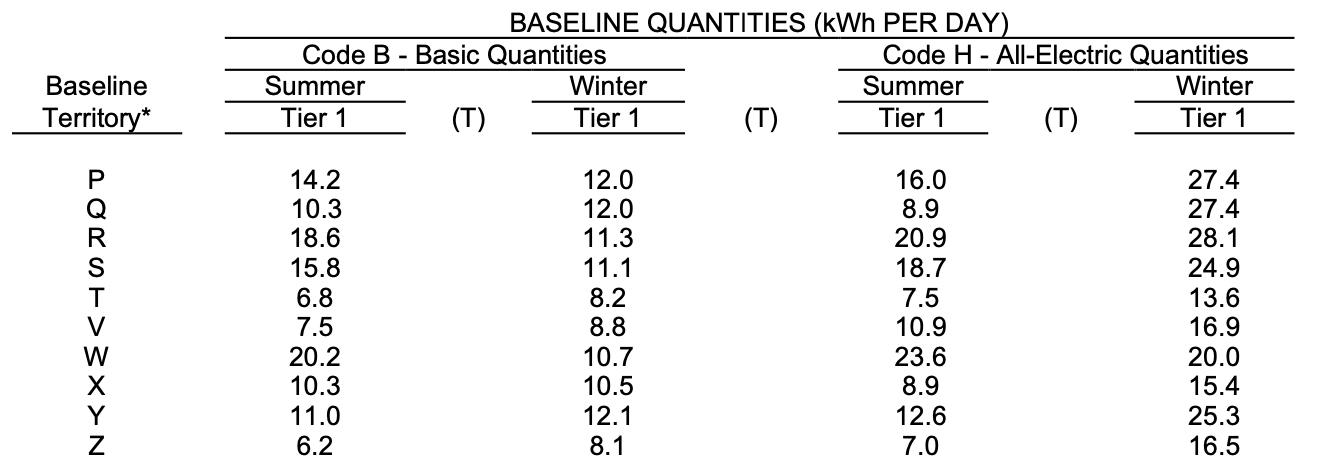
Let’s say there are 30 days in a billing cycle and you live in Baseline Territory “S” and have gas heating, your baseline allocation (Tier 1 quantity) for that billing cycle would be 474 kWhs in the Summer and 333 kWhs in the Winter.
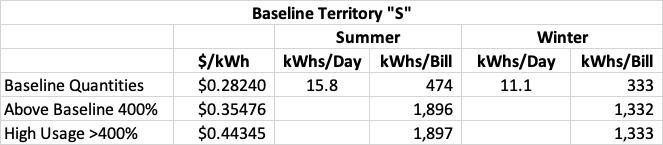
Once you have used more than your baseline allocation of 474 kWhs in a billing cycle the cost for every kWh you use above that amount until you reach 400% of the baseline amount will be at the Tier 2 rate and will increase from 28 cents to 35 cents per kWh, a 35% increase in cost. If you exceed 400% of the baseline quantity Tier 3 costs are applied, an increase of 57% over the baseline rate.
Remember: THE MORE YOU USE, THE MORE IT COSTS PER KWH!
PG&E E-TOU-C Rate Schedule
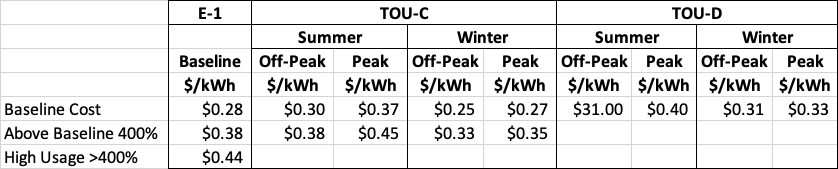
PG&E is migrating all of their Residential E-1 Rate customers to the TOU-C Rate, with some exceptions which will be discussed below. Time-of-use rates have been around for a while. They are useful for people who aren’t at home during peak hours or who use very little energy. A time-of-use schedule allocates costs based on the time a customer uses electricity. In the past there has been very little use of electricity during the night and early morning and on weekends and the off-peak rate was significantly lower, unlike today. These were useful for charging electric vehicles or having indoor grow operations.PG&E has a few TOU rate plans with different peak and off-peak periods. “Peak” is between 4 – 9 PM (TOU-C) or 5 – 8 PM (TOU-D).

As you can see in the graphic above, and what PG&E has never mentioned, is that the TOU-C Rate is actually a hybrid rate scheme with both time-of-use and tiered systems combined. The lowest cost electricity will still be on the E-1 baseline rate of $0.28/kWh (as of Jan. 1, 2022 with another rate hike on the way). The off-peak baseline rate on the TOU schedule will be higher $0.30 – $0.31/kWh. PG&E will allow customers who want to to opt out of the E-TOU-C rate and continue with the E-1 rate schedule.
Automatic Enrollment – Opt Out or Keep the E-TOU-C Rate
All of PG&E’s customers will be automatically enrolled in the E-TOU-C rate schedule, except for low-income CARE customers. PG&E will guarantee that your bills will not increase during the first year and if they do PG&E will rebate each customer the difference between what they would have paid on the E-1 rate vs. the TOU-C rate, but only for the first year. The CPUC will allow customers to opt out of the TOU rate at any point and go back to the E-1 rate.
Rate Plan Comparison Tool
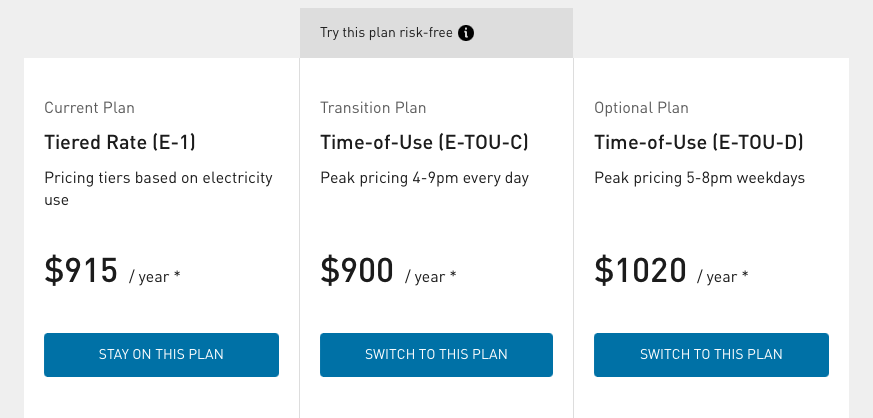
On your account page on PG&E’s website you can access a rate comparison tool. A third-party provider analyzes your current energy consumption and calculates how much you use and when (based on smart meter analysis) and compares the different rates. The graphic below is from that webpage and shows that I would save $15/year by switching to the E-TOU-C. I personally do not trust this analysis because as I have shown in the table above the lowest E-TOU-C rates are higher than the E-1 rates; therefore, it is impossible to cost less when the cost per kWh is more. In fact, the letter I received from PG&E about the April 19, 2022 transition to the E-TOU-C rate stated that it will cost me about $50/year more than staying on the E-1 rate. Your costs and savings will be different than what I’ve shown below as your usage is different than mine.
Coping with Higher Rates – CARE and FERA
There isn’t much middle and high-income utility customers can do about PG&E’s rates except install a solar system and produce your own electricity, but even that is going to cost you soon to protect the IOU’s profits. If you are a cash-strapped, low-income IOU customer in California you are in luck. The CPUC developed two-different rate schedules to give low-income and low to moderate-income customers rate assistance. These are the CARE and FERA rate programs offered by California’s IOU and paid for by all rate payers with the public benefits charges on your billing statement. Yes, that is right each IOU customer pays a Public Purpose Program surcharge on their bill to subsidize these rates and other programs.
CARE
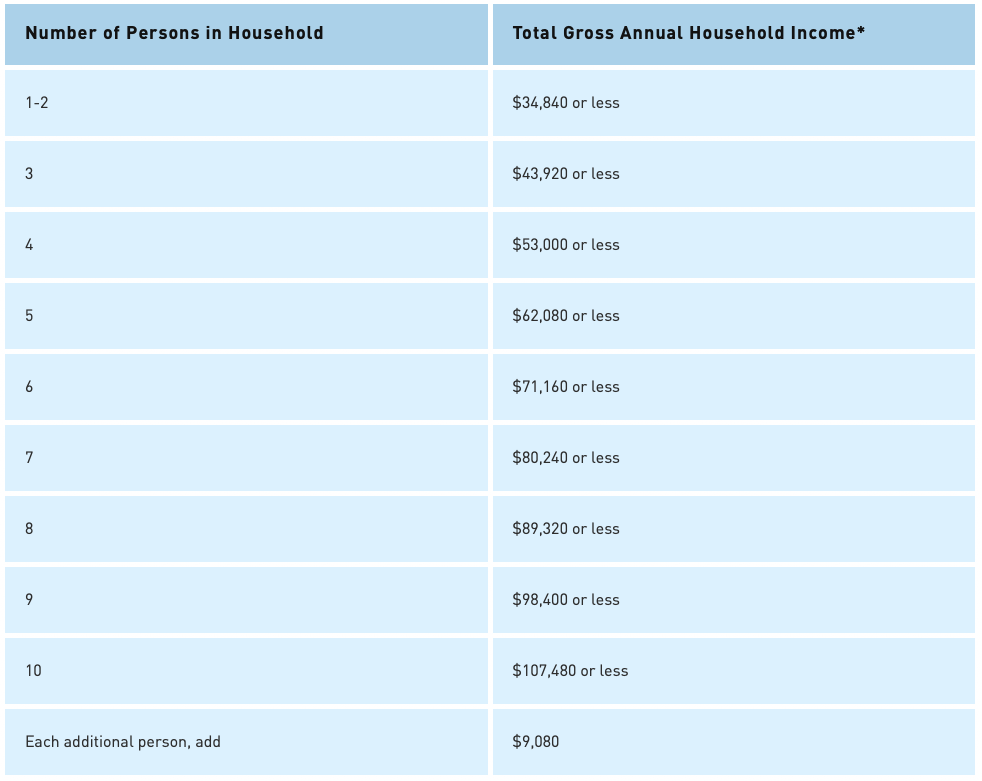
The California Alternative Rate for Energy or CARE is an income qualifying rate assistance program that can reduce your electrical costs by over 50% and natural gas costs by 20%. It provides a significant saving to income qualified households. There are two ways to qualify for CARE, either by qualifying in a public assistance program or by income.
A household may qualify for the CARE Program if someone in your household takes part in any of the following public assistance programs. It only takes one person in the household on one of these programs to qualify the whole household.
- Low Income Home Energy Assistance Program (LIHEAP)
- Women, Infants, and Children (WIC)
- CalFresh/SNAP (Food Stamps)
- CalWORKs (TANF) or Tribal TANF
- Head Start Income Eligible (Tribal Only)
- Supplemental Security Income (SSI)
- Medi-Cal for Families (Healthy Families A & B)
- National School Lunch Program (NSLP)
- Bureau of Indian Affairs General Assistance
- Medicaid/Medi-Cal (under age 65)
- Medicaid/Medi-Cal (age 65 and over)
CARE income qualifying is based on federal income guidelines for low-income households. Total gross annual income is used to qualify the household from all income sources in the household.
FERA
FERA is the Family Energy Rate Assistance program and is similar to CARE except there has to be two more more people in the household to qualify and the income levels are higher. If your household doesn’t qualify for CARE it may qualify for FERA. Gross annual household income is higher than for the CARE program and the discount is 15 – 20% off electricity only.
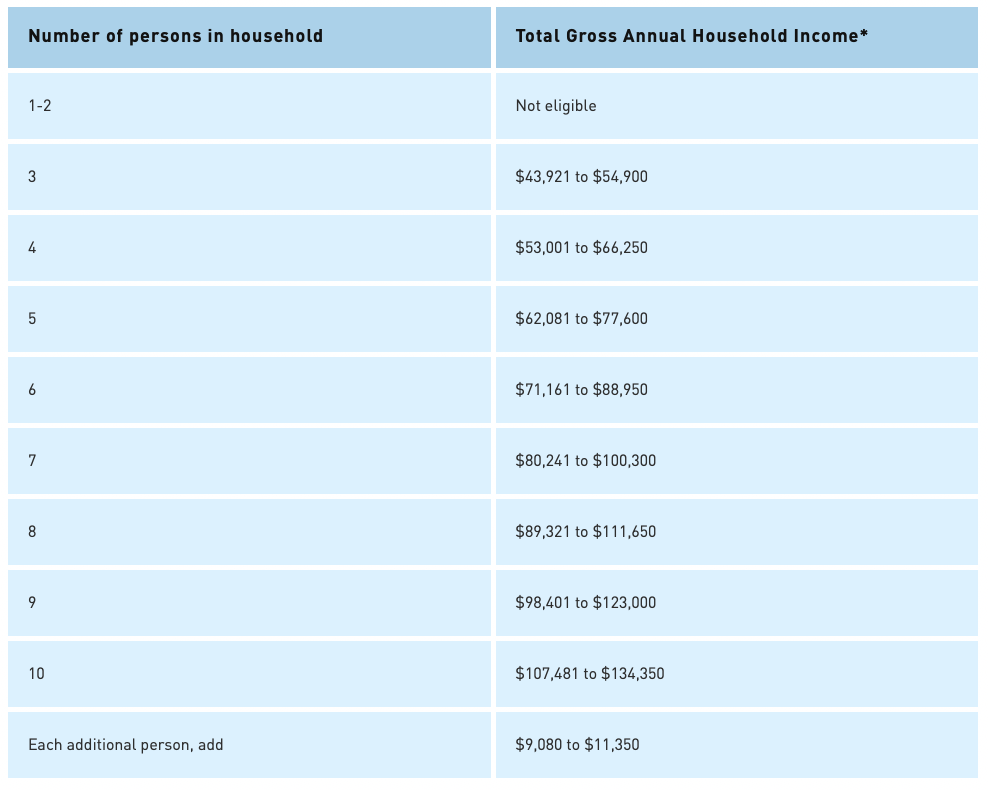
If your household’s gross annual income meets these criteria take advantage of the rate assistance program. Call PG&E’s Customer Service Department 1-(800) 743-5000 to start CARE or FERA.
Rate Increases 2012 – 2022
PG&E Electric Price Increases
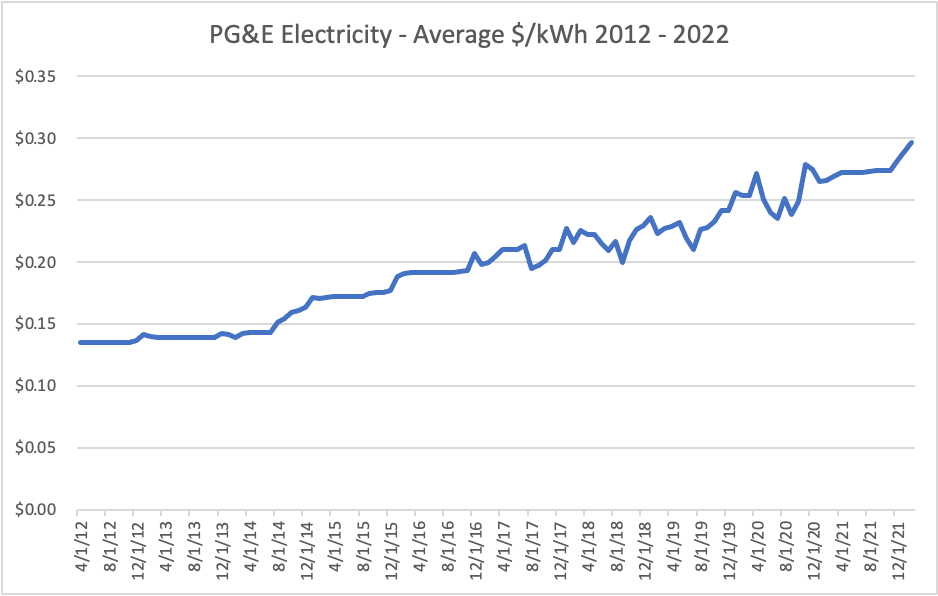
PG&E electric rates have steadily increased over the past eight years. The graph below shows that starting in 2014 my average cost for standard E-1 Tiered electricity increased from $0.14/kWh in 2014 to $0.30/kWh in 2022, a 114% increase. Inflation during this same period grew a little over 2% per years and only rose 20.2% over this eight-year period.
The graph below represents the average cost per kilowatt hour ($/kWh) from a download of my actual bills and not the posted rate amounts. If you want to see what you’ve paid on your utilities access your account on PG&E’s website and download the data (www.pge.com). This average cost is my total billed amount and includes all the tiered costs as well as taxes and surcharges and it represents the actual billed costs.
Average rates have more than doubled from. This is a 114% increase in electric costs over eight years.
PG&E Natural Gas Price Increases
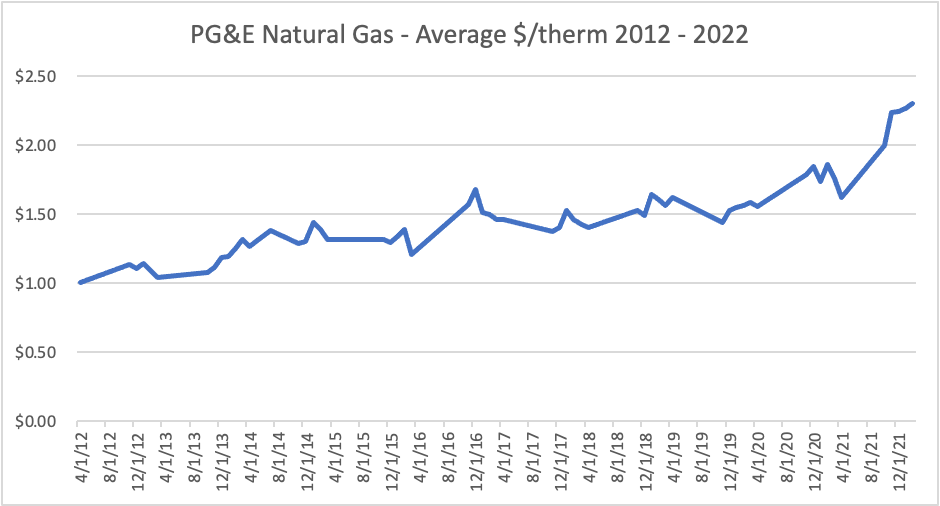
PG&E’s natural gas prices have also drastically increased over the past ten years from around $1.00/therm in 2012 to $2.30/therm at the start of 2022, an increase of 230% while inflation was around 24% for the same time period.
Your Billing Statement
If you haven’t spent time looking at your billing statement you should take the time and look at it. The devil is in the details.
Do you get a billing statement? If you are like me and changed over to electronic billing to stopped getting mailed billing statements, you no longer see any details, you get an email stating what you owe. The details are important, but they can only be found on the paper billing statement, which you can get a pdf version from your account on PG&E’s website.
Are you signed up for PG&E “Your Account” website (www.pge.com)? I highly recommend it if you are not. There is a lot of useful information on the website and some not-so useful information. One of the things that is missing from the electronic, web-page billing statement is the details of the charges. The paper statement shows how much electricity and natural gas you consume in each tier and at what cost, the electronic statement does not show this and you have to download a pdf version to see it.
Breakdown of Charges
You pay for more than just electricity on your utility bill. There are a number of charges, surcharges, and taxes that get incorporated into your bill that affect the cost of electricity. You need to be aware of these for both electricity and natural gas portions of your bill.
The table below is made up of the charges PG&E places on your electrical bill. It is from an actual bill, mine for the month of January, 2022. Your’s will be different. The percentages should stay pretty much the same and only the cost change.
As you can see in the table below a lot of different charges are added to your electric bill. There is only one additional charge on the Natural Gas bill and that is for the Public Purpose Program. Overall the three largest charges are for generation, transmission, and distribution. They make up about 90% of a residential bill.
When you are transitioned to Butte County’s CCA (Community Choice Aggregator) in the coming years the only thing that will change on the charges is that your electricity will be provide by another generator and where it says “Generation” it will say “Butte Choice CCA” and their charge for your electricity will be inserted there.
| PG&E Electric Charges Breakdown | ||
| Conservation Incentive | -$8.56 | |
| Generation | $43.51 | 37.5% |
| Transmission | $13.34 | 11.5% |
| Distribution | $44.87 | 38.7% |
| Subtotal | $101.72 | 87.7% |
| Electric Public Purpose Programs | $6.01 | 5.2% |
| Nuclear Decommissioning | $0.35 | 0.3% |
| Wildfire Fund Charge | $2.21 | 1.9% |
| Wildfire Hardening Charge | $0.28 | 0.2% |
| Competition Transition Charge | $0.02 | 0.0% |
| Energy Cost Recover Charge | $0.12 | 0.1% |
| Taxes and Other | $5.22 | 4.5% |
| Subtotal | $14.21 | 12.3% |
| Total | $115.93 | 100% |
The three most critical components of electric charges are the generation, transmission, and distribution charges.
Generation charge is the cost to produce a kilowatt hour of electricity. This charge can vary on each bill because the cost to produce energy changes by season and demand.
Transmission charge is the cost to move electricity from the power plant to the distribution centers and tends to be fairly static because it is more of a fixed cost.
Distribution charge is the cost to move electricity from a distribution center through the local power grid to your home. It covers the cost to provide and maintain the power poles, lines, transformers, and meters.
Conservation Incentive is an incentive paid to customers who conserve energy and stay inside their Tier 1 quantities.
Electric Public Purpose Programs – this is a surcharge paid by all ratepayers to cover the cost of the utilities’ assistance programs. This surcharge was put in place by California law and distributes billions of dollars every year to low-income assistance programs including the CARE, FERA, Energy Savings Assistance, and rebate programs.
Nuclear Decommissioning charges pay for decommissioning PG&E’s nuclear power plant in Humboldt Bay and soon Diablo Canyon nuclear power plant will be added to this charge.
Wildfire Fund Charge is a surcharge on bills to fund a California Department of Water Resources (DWR) for cost related to California’s 2001 Energy Crises.
Wildfire Hardening Charge is new and PG&E doesn’t explain it on their website; however, it most likely is what its name implies – a charge to upgrade PG&E’s system to prevent wildfires but it doesn’t seem like enough.
Competition Transition Charge is assessed to pay for costs incurred by PG&E for electricity prior to 1998.
Energy Cost Recover Charge pays for PG&E bankruptcy.
Taxes and Other – are just that, undefined taxes and other charges.
 EEECo Chico